




Handheld Nickel Strip Spot Welding Pen with Dual Copper Electrodes, Spring-Loaded Head and Trigger Cable for 18650 Li-ion Battery Packs by Electrica
12 in stock
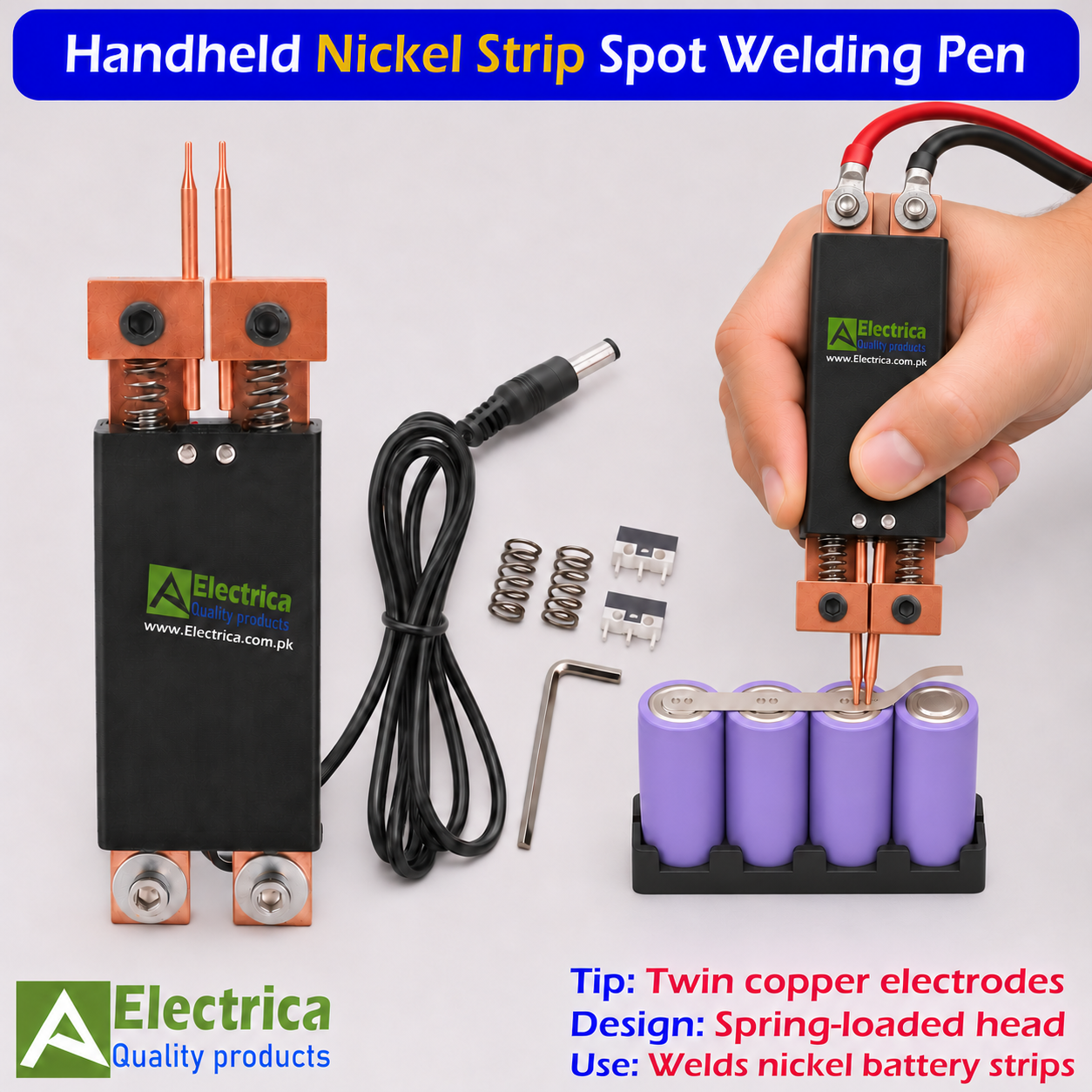
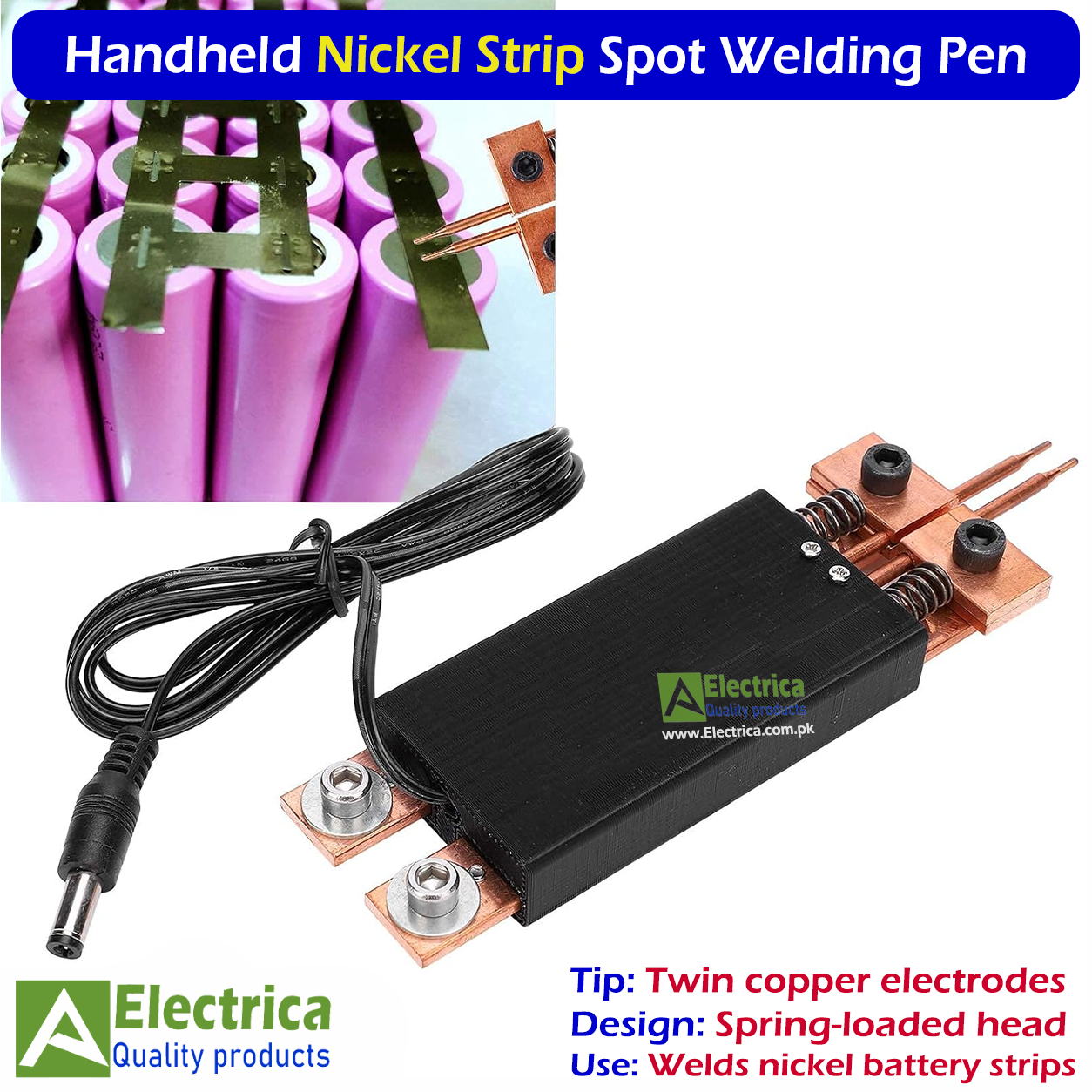
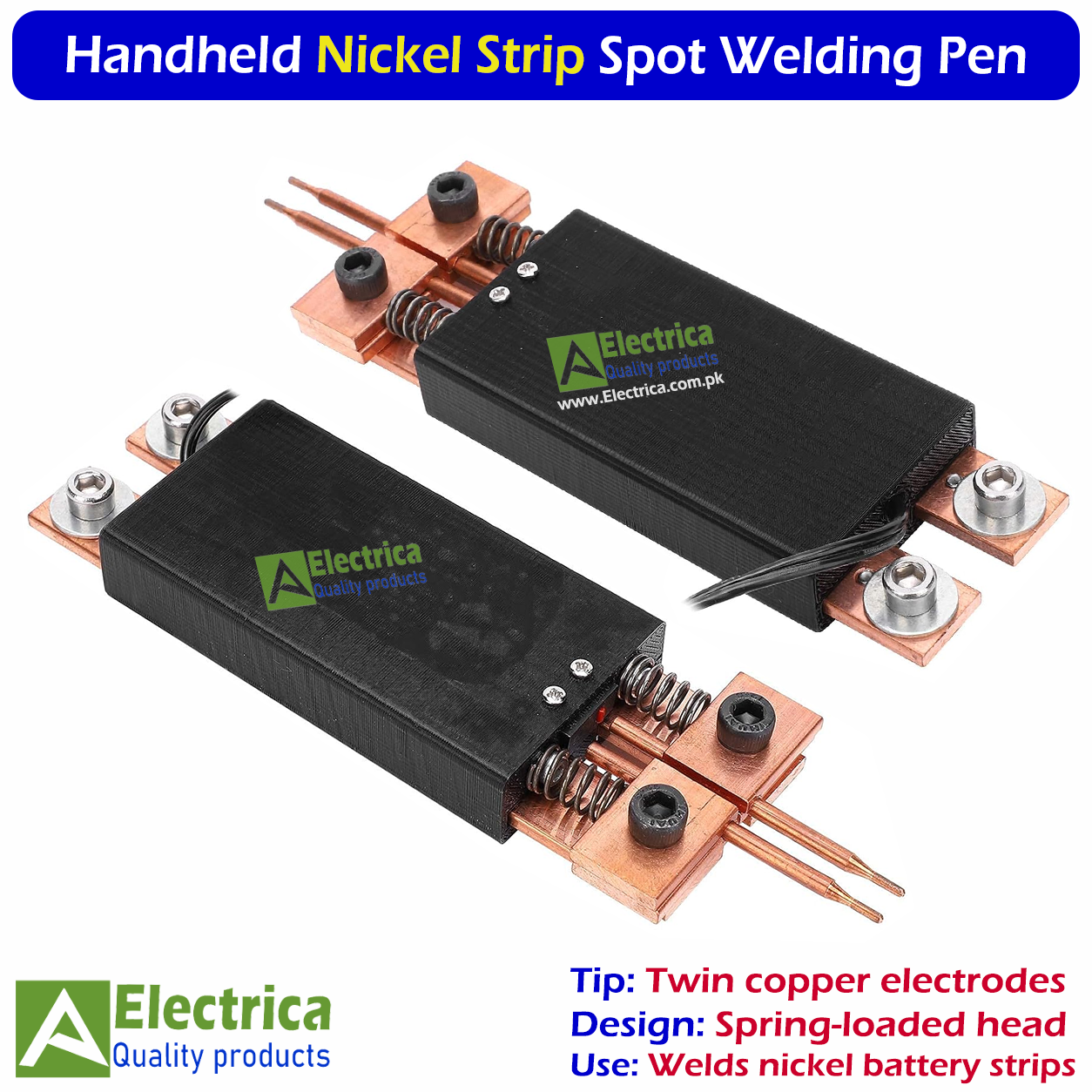
Build battery packs with precision using this handheld spot welding pen, featuring twin copper electrodes, a spring-loaded head and a compact design for nickel strip welding.
- Application: Nickel strip welding on 18650 cells.
- Electrodes: Twin copper tips.
- Welding Head: Dual spring-loaded design.
- Tip Adjustment: Individual hex socket screws.
- Power Connection: Two rear copper terminals.
- Trigger Cable: Barrel-type plug.
₨ 2,875
12 in stock
CompareThe Handheld Nickel Strip Spot Welding Pen is a practical battery assembly accessory designed for welding nickel strips onto cylindrical battery cells using a compatible external spot welding machine. Featuring twin copper electrodes, a spring-loaded welding head and a compact handheld body, this welding pen is suitable for lithium-ion battery pack assembly, battery repair and DIY electronics projects.
Its handheld configuration allows users to position both welding electrodes over the intended welding area using one hand. This arrangement is particularly useful when assembling battery packs that require multiple individual welds across cell terminals and nickel strip connections.
Product Specifications:
- Product type: Handheld spot welding pen
- Electrode material: Copper
- Electrode setup: Twin welding electrodes
- Welding head: Dual spring-loaded mechanism
- Electrode mounting: Hex socket screws
- Body colour: Black
- Power terminals: Two copper screw terminals
- Trigger connection: Barrel-type connector
- Operation: Handheld
- Compatibility: Select external spot welders
- Welding use: Nickel battery strips
- Battery use: 18650 Li-ion pack assembly
- Maintenance: Easy electrode access
- Accessories shown: Springs, switch parts and Allen key
The Handheld Nickel Strip Spot Welding Pen is a practical accessory for battery pack assembly and repair. Featuring twin copper electrodes, the Handheld Nickel Strip Spot Welding Pen provides controlled electrode contact during welding. Its spring-loaded design makes the Handheld Nickel Strip Spot Welding Pen suitable for precision nickel strip positioning. When connected to compatible welding equipment, the Handheld Nickel Strip Spot Welding Pen can be used for lithium-ion battery projects. Choose the Handheld Nickel Strip Spot Welding Pen for your battery assembly and electronics workshop requirements.
FAQ: Handheld Nickel Strip Spot Welding Pen
1. What is the spot welding pen used for?
It is used to weld nickel strips to battery cell terminals during pack assembly or repair. A compatible external spot welder supplies the welding current.
2. Why does the pen have two copper electrodes?
Copper conducts the welding current to the workpiece. Having both tips in one handle lets you position them together on the nickel strip with one hand.
3. How does the spring-loaded head work?
Each electrode moves under pressure. The springs help both tips stay in contact with the nickel strip when the surface is slightly uneven.
4. Can the electrode tips be adjusted?
Yes. Each tip has its own hex socket screw, so you can inspect or adjust it individually. Disconnect the welding equipment from power before making adjustments.
5. What equipment does the pen require?
You need a compatible external spot welding controller, a suitable power source and high-current welding cables. Check that the controller supports the pen’s trigger connection.
6. What are the rear copper terminals for?
The two rear screw terminals connect to the high-current cables from the external welder. These connections carry the welding pulse to the copper tips.
7. What is the barrel-type connector for?
It connects the pen’s trigger cable to a compatible controller. A barrel plug can also fit some DC power sockets, so check the controller’s connection diagram before plugging it in.
8. Can the pen be used with 18650 cells?
Yes. The pen is designed for welding nickel strips to compatible 18650 lithium-ion cells. For other cylindrical cells, check tip clearance and the cell manufacturer’s assembly guidance.
9. Does it support series and parallel battery packs?
Yes. The pen makes individual strip-to-terminal welds in either layout. Typical applications include rechargeable lighting and portable electronics.
10. What nickel strip thickness can it weld?
The pen has no specified maximum strip thickness. Check your external welder’s rating for the nickel strip material and thickness you plan to use.
11. What affects weld consistency?
Pulse energy, strip thickness, contact pressure and electrode condition all affect the weld. If results vary, check both tips for dirt, damage or loose mounting screws.
12. Which accessories are shown with the pen?
The product images show two additional springs, two small switch components and one Allen key. Check the package contents to confirm which items come with your order.
13. How should the pen be maintained?
Disconnect the equipment from power before servicing. Inspect the electrode tips, mounting screws, rear terminals and trigger cable, and check that both springs move freely.
14. What precautions should I take when welding lithium-ion cells?
Follow the cell and welder manufacturers’ instructions, wear suitable protective equipment and check tip placement before triggering a weld. Incorrect settings or a short circuit can damage cells and cause a fire.
15. Who is this welding pen suitable for?
It suits battery pack builders, repair technicians and hobbyists with a compatible spot welder. The compact handle is especially useful when repositioning both tips for repeated welds across a pack.
Explore our range of Nickel Strips, 18650 Lithium-Ion Batteries, Battery Management Systems (BMS) and Battery Pack Assembly Accessories to complete your battery welding projects.
For more technical information about resistance welding and battery pack assembly, visit AMADA WELD TECH
| Weight | 0.35 kg |
|---|---|
| Dimensions | 10 × 12 × 10 cm |
| Product Type | Spot Welding Pen |
| Electrode Material | Copper |
| Electrode Type | Dual Electrode |
| Head Mechanism | Spring-Loaded |
| Connection Type | Screw Terminals |
| Application | Nickel Strip Welding |
| Operation | Handheld |
| Colour | Black / Blue |
| Trigger Connector | Barrel Type |
| Battery Compatibility | 18650/26650 Li-ion etc. |
Based on 0 reviews
Be the first to review “Handheld Nickel Strip Spot Welding Pen with Dual Copper Electrodes, Spring-Loaded Head and Trigger Cable for 18650 Li-ion Battery Packs by Electrica”
Related products
-
All Products, Soldering Tools & Accessories, Tools & Repair Equipment
V52 Heat Resistant Silicone Soldering Repair Mat 320×228mm – Non-Slip Electronics PCB & Mobile Phone Repair Work Mat – Electrica
 All Products, Soldering Tools & Accessories, Tools & Repair Equipment
V52 Heat Resistant Silicone Soldering Repair Mat 320×228mm – Non-Slip Electronics PCB & Mobile Phone Repair Work Mat – Electrica
The V52 Heat Resistant Silicone Repairing Mat is a flexible, non-slip electronics repair work mat designed for mobile phone servicing, PCB maintenance, and precision assembly. Its 320 × 228 mm surface includes integrated storage compartments and a small screw positioning grid for organising components.
- Model: V52 Silicone Repairing Mat
- Material: Flexible Silicone Construction
- Size: 320 × 228 mm (12.6 × 9.0 Inches)
- Heat Resistance: Designed for Electronics Repair Work
- Surface: Non-Slip Work Area
- Applications: Mobile Phone, PCB and Electronics Repair
- Suitable For: Technicians, Engineers, Students and DIY Enthusiasts
SKU: 1x V52 Silicon Reparing Mat -
All Products, DC-DC Boost Converter, DC-DC Converters
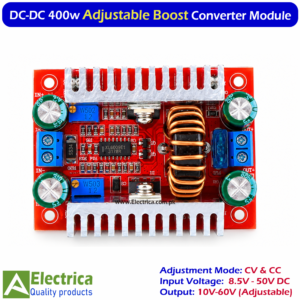
400W DC-DC Boost Converter Module 8.5V–50V to 10V–60V Adjustable Step-Up Voltage Regulator with CC/CV Control – Electrica
 All Products, DC-DC Boost Converter, DC-DC Converters
400W DC-DC Boost Converter Module 8.5V–50V to 10V–60V Adjustable Step-Up Voltage Regulator with CC/CV Control – Electrica
The 400W DC-DC Boost Converter Module is an adjustable step-up voltage regulator designed for high-power DC conversion applications. Featuring 8.5V–50V DC input, 10V–60V adjustable output, and independent Constant Voltage (CV) and Constant Current (CC) controls, it provides flexible voltage and current regulation for electronics projects, laboratory testing, and compatible battery charging systems.
Key Features:
- Power Rating: Up to 400W.
- Input Voltage: 8.5V–50V DC.
- Output Voltage: 10V–60V adjustable DC.
- Control Modes: CV and CC adjustment.
- Cooling: Dual aluminum heatsinks.
- Connections: Screw terminal input and output.
- Applications: DC power supplies, robotics, electronics testing, and DIY projects.
Package Includes: 1 × 400W DC-DC Boost Converter Module.
SKU: 1x 400w CC-CV Boost Converter -
All Products, Soldering Tools, Tools & Repair Equipment
TE-805 5X Magnifying Helping Hand Soldering Stand with Adjustable Arms, Dual Alligator Clips & Metal Base by Electrica
 All Products, Soldering Tools, Tools & Repair Equipment
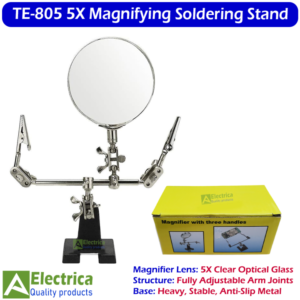
TE-805 5X Magnifying Helping Hand Soldering Stand with Adjustable Arms, Dual Alligator Clips & Metal Base by Electrica
- Model: TE-805
- Magnification: 5X clear optical glass lens
- Lens Diameter: Approximately 62 mm
- Holding Clips: Two metal alligator clips
- Arm Structure: Fully adjustable metal joints
- Base: Heavy, stable metal base
- Base Design: Anti-slip design as shown
- Application: PCB inspection and electronics repair
- Work Support: Holds small components and wires
- Use: Soldering preparation, assembly and DIY projects
- Product Type: Magnifying helping hand stand
- Brand: Electrica
SKU: 1x TE805 Helping Hand -
All Products, Charging Modules, DC-DC Converters, Mobile & Gadget Accessories, USB Fast Charging Modules
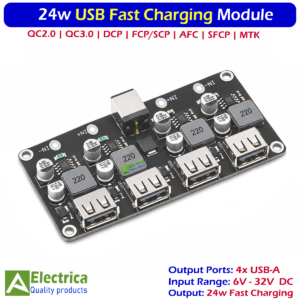
4 USB QC3.0 QC2.0 Fast Charging Buck Converter 6V–32V to 5V High-Speed Mobile Charging Module with Overcurrent Protection by Electrica
 All Products, Charging Modules, DC-DC Converters, Mobile & Gadget Accessories, USB Fast Charging Modules
4 USB QC3.0 QC2.0 Fast Charging Buck Converter 6V–32V to 5V High-Speed Mobile Charging Module with Overcurrent Protection by Electrica
- Input Voltage: 6V–32V DC
- Output Voltage: 5V (Auto-adjusts to 9V/12V when QC is triggered)
- Fast Charging Support: QC3.0 / QC2.0 / AFC / FCP / SCP / PE+
- USB Ports: 4 Independent High-Speed Ports
- Output Current: Up to 3A per port
- Maximum Output Power: 24W high-efficiency module
- Conversion Efficiency: Up to 95%
- Protection Features: Overcurrent / Short Circuit / Over-Temp / Reverse Polarity
- Application: DIY, Automotive, UPS, Solar, Power Bank, Robotics
- Build Quality: High-grade PCB with heat-resistant components
SKU: 1x 4-Channel Fast Charger Black -
All Products, Amplifier Boards, Audio & Amplifier Modules
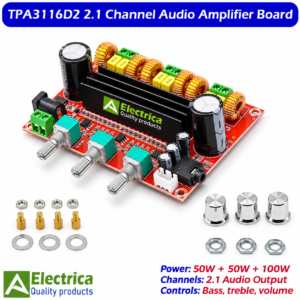
TPA3116D2 2.1 Channel Audio Amplifier Board – 50W × 2 Stereo + 100W Subwoofer, Class D Amplifier Module with Bass, Treble & Volume Controls | Electrica
 All Products, Amplifier Boards, Audio & Amplifier Modules
TPA3116D2 2.1 Channel Audio Amplifier Board – 50W × 2 Stereo + 100W Subwoofer, Class D Amplifier Module with Bass, Treble & Volume Controls | Electrica
- Amplifier IC: TPA3116D2
- Amplifier Type: Class D Audio Amplifier
- Audio Configuration: 2.1 Channel Output
- Stereo Output: 50W × 2 (claimed)
- Subwoofer Output: 100W (claimed)
- Total Advertised Power: 200W
- Audio Controls: Volume, Bass and Treble
- Power Input: 12V–24V DC (as indicated in product image)
- Cooling: Aluminium Heatsink
- Speaker Outputs: Left, Right and Subwoofer
- Control Interface: Three Rotary Potentiometers
- PCB Dimensions: Approximately 102 × 70 mm
- Board Height: Approximately 28 mm
- Applications: DIY Home Audio, Stereo Speakers and Subwoofer Systems
SKU: 1x TPA3116d2 3-Voume Red Amplifier
There are no reviews yet.